Repiping means replacing the pipes that carry drinking water around a house: the hot and cold supply lines from the main shutoff to every faucet, toilet, shower and appliance. In Columbus that usually means taking out galvanized steel or aging copper and putting in PEX or new copper, under a plumbing permit, then testing the new system before the walls close. Slate Repiping Columbus offers and manages whole-house and partial repipes across Columbus and nearby Franklin County communities, carried out by licensed and insured plumbing contractors. This guide covers how the whole process works, from the first symptom to the final inspection.
What the water supply system is
Every house has two separate plumbing systems. The supply side carries clean water under pressure; the drain, waste and vent side carries used water away by gravity. A repipe deals only with the supply side, which is why the guide to whether repiping includes drain pipes exists: the two are often confused.
The supply side starts outside. A buried service line runs from the water main in the street to the house, and in most Columbus homes it comes through the basement wall near the inside water meter. Just past the meter is the main shutoff, and that is where a repipe begins. From there a main line runs to the water heater and splits into cold and hot. Branches feed each fixture group: the kitchen, each bathroom, the laundry, the outside hose bibbs.
That layout is called trunk-and-branch, and it is how most older houses were piped. Newer PEX systems can also use a home-run manifold, where each fixture gets its own line from a central panel of valves. The manifold vs trunk-and-branch guide explains the difference.
What older Columbus houses were piped with
The pipe in a house mostly follows the decade it was built or last remodeled.
- Galvanized steel was the standard supply pipe for much of the first half of the twentieth century. It is gray, threaded at every joint, and magnetic. Columbus stopped allowing new galvanized and lead service lines in December 1963, a useful marker for the era.
- Copper took over from the middle of the century. Copper joined before 1986 may have lead solder at its joints, because that is when lead solder was banned in home plumbing, and brass fittings could contain up to 8% lead until 2014, according to the City.
- Polybutylene, a gray plastic, appeared in some homes built or remodeled in the 1980s and 1990s.
- PEX and CPVC are the plastics in most new work today.
Columbus’s housing is younger than many Midwest cities’: the Census Bureau counts 12.0% of its homes as built before 1940. The older stock is concentrated, though. More than half of the homes in the 43206 ZIP around German Village are pre-1940, and Bexley and Grandview Heights are each above 40%. The guide to identifying your pipe material shows how to tell the materials apart with a magnet and a coin.
Why those materials were used in the first place
Each pipe in an older house was a reasonable choice when it went in. Galvanized steel was strong, cheap and could be threaded on site with hand tools, and the zinc coating was meant to keep the steel from rusting. It did, for a few decades. Nobody installing it in the 1920s expected the house to still be drinking through it a century later.
Copper replaced it because copper does not rust the way steel does, takes up less room, and joins with solder instead of threads, so the wall is not cut away at every fitting. Many Columbus houses built in the 1950s and 1960s still run on their original copper, and much of it is fine; copper repiping is for the systems that are not. Polybutylene was cheap and quick to install, which is why builders used it, and why its fitting failures were a surprise. PEX came into wide use because it is flexible, quick to run through a finished house and resists the scale that chokes steel.
Knowing why a material was chosen helps explain how it fails. Galvanized was strong but not corrosion-proof. Copper resists corrosion but is sensitive to water chemistry, velocity and workmanship. Plastics avoid corrosion but depend on listed fittings, correct support and protection from sunlight and heat. No material is a forever pipe, and no honest quote calls one that.
Why old supply pipe fails
Galvanized steel corrodes from the inside. The zinc coating wears through, the steel beneath rusts, and rust and scale build on the pipe wall. The bore narrows a little each year. The first sign is usually flow, not a leak: the upstairs shower fades when the kitchen tap opens, or the first water after a weekend away runs brown. Threaded joints rust through first because threading cuts away part of the wall. The guide to whether galvanized pipes are safe covers what that means for water quality.
Copper fails differently. Pinhole leaks have several possible causes: water chemistry, fast flow in undersized lines, flux left inside joints, and stray electrical current. Columbus lime-softens its water to about 5.7 to 7.3 grains per gallon and adds a zinc orthophosphate corrosion inhibitor, according to the City’s water quality report, which protects pipe walls. So one pinhole in a Columbus house does not prove the whole system is failing. A pattern of them in the same run is a different matter, and the copper pinhole leak guide walks through how to read it.
Polybutylene fails at its fittings, which is why it is usually replaced as a system rather than patched.
Freezing is a separate risk. Columbus averages about 103 nights a year at or below freezing at the airport station, by NOAA’s climate normals. Pipe in an exterior wall, a crawlspace or an unheated garage can freeze whatever it is made of. A repipe is a chance to move lines to interior walls, but new pipe alone does not remove freeze risk.
Symptoms, and what they do and don’t prove
| What you notice | What it can mean | What else causes it |
|---|---|---|
| Low flow at several fixtures | Scaled galvanized main or branches | Service line, a partly closed valve, a failing pressure-reducing valve |
| Low flow at one fixture | A clogged aerator or cartridge, or one bad branch | Usually not the whole system |
| Rusty water that clears after running | Corroded steel pipe in the house | Water heater sediment, City main work nearby |
| Repeat pinholes in one copper run | Wall thinning in that run | Velocity, workmanship, electrical current |
| Water hammer, banging pipes | Fast-closing valves, loose pipe | Pressure that is too high |
None of these proves one cause by itself. That is why a repipe starts with the pipe traced from the meter and with pressure and flow checked, not with a sales pitch. The low water pressure page and the rusty water guide go deeper on the two most common complaints.
Not sure what your symptoms mean?
A walk-through traces the pipe from the meter and checks pressure and flow before anyone talks about scope.
Assessing a house before deciding
The decision starts with a short list of facts, and most of them can be gathered before anyone opens a wall.
What the pipe is. A magnet sticks to galvanized steel and not to copper or plastic. Scratching a gray pipe shows whether it is steel, which looks silver, or lead, which is soft and dull. Gray plastic stamped “PB” is polybutylene. Most houses show a mix: steel near the meter, copper where a past owner fixed a leak, and steel again further up.
Where the old pipe goes. Following the main from the meter across the basement ceiling shows the trunk, the branches and where pipe disappears into walls. Each place it climbs is a likely opening later.
How the water behaves. Static pressure at a hose bibb or test point says what the street is delivering. Flow at the highest fixture with a second tap open says what the house piping is letting through. A big gap between the two points at the pipe; a low reading at both points at the service or a pressure-reducing valve.
The history. How many leaks, where they were, and whether they were in the same run. Three pinholes in the same horizontal line in the basement ceiling tell a different story from three unrelated drips over twenty years.
What is planned anyway. A kitchen or bath remodel opens walls for free. The City’s service line work opens the basement wall near the meter. A sale puts an inspector’s eyes on the pipe. Timing a repipe around any of these saves openings and disruption.
Doubles, apartments and buildings with more than one household
Columbus has a lot of two-to-four-unit housing in its older neighborhoods. In the 43201, 43202, 43205 and 43206 ZIPs, roughly one in five homes sits in a building of two to four units, by the Census Bureau’s count. Those buildings bring three extra questions.
The first is which unit each line feeds. Some doubles have two meters and two mains; others share a main with branches that cross the party wall. A scope that covers one side has to say where the boundary is, or the new side can still draw rusty water from the old one. The second is the shutoff plan: every household needs to know when its water is off. The third is the permit. Inside Columbus, a building of four or more units moves to the multi-family permit, which costs $550 with one inspection or $700 with two, and a full system replacement needs plan review. The commercial and multi-unit repiping page covers those jobs.
Scope: repair, partial repipe or whole house
There are three honest answers to old pipe, and the right one depends on how much of it is still doing its job.
A spot repair replaces one leaking section. It fits a single leak in otherwise sound piping, and it is the cheapest choice today, but the pipe on either side keeps aging. A partial repipe replaces a defined part, such as one bathroom group, one floor or the hot side, and leaves the rest. It fits when one area is clearly worse or the budget has to be staged, and the scope must list the old pipe that stays. A whole-house repipe replaces every supply line from the main shutoff. It fits galvanized throughout, repeat leaks on several lines, or low flow at several fixtures. The repipe vs repair guide sets out where the line usually falls.
PEX or copper
The Ohio Plumbing Code, which governs plumbing in 1, 2 and 3 family homes under the Residential Code of Ohio, is built on the 2021 International Plumbing Code. That code lists PEX, CPVC and copper tube for water distribution, so in Columbus the choice is about the house rather than the law.
PEX is flexible. It bends around joists and runs long distances with few fittings, which usually means fewer and smaller wall openings, and it usually costs less. Copper is rigid and metal; it suits runs that stay exposed and owners who prefer it, and it costs more, with copper mill prices up about 30% over the past year in the Bureau of Labor Statistics producer price index. Neither is right for every house. The PEX vs copper guide and the guide to whether PEX is safe for drinking water cover the details.
Permits and who can do the work
A repipe needs a plumbing permit. Inside the City of Columbus, Building and Zoning Services issues it; for a 1, 2 or 3 family home it costs $275 with two inspections. The permit is pulled by a plumbing contractor licensed by the Ohio Construction Industry Licensing Board and registered with the City, or by an owner doing the work on a single-family home they live in.
Many suburbs work differently. In Upper Arlington, Bexley, Grandview Heights, Whitehall, Westerville, Dublin, Hilliard, Gahanna and Reynoldsburg, among others, the city issues the permit and Franklin County Public Health reviews the plan and inspects the plumbing. Since February 2026, those permit applications have to include the county’s plan review approval. The Columbus repiping permit guide covers each office.
How the work happens
A repipe follows the same stages in a ranch, a double or a small apartment building.
- First call. The house’s age, what pipe shows in the basement, the leaks so far, and which fixtures lose pressure.
- Walk-through and scope. The pipe is traced from the meter, pressure and flow are checked, and a written scope sets the material, the routes, the openings, what old pipe stays and the permit.
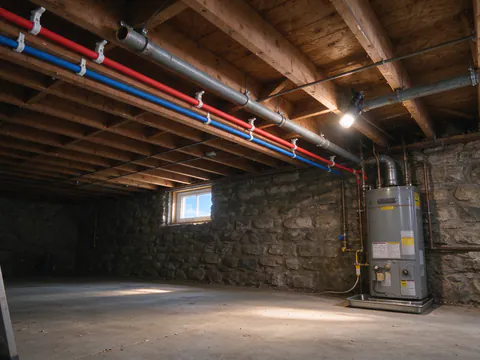
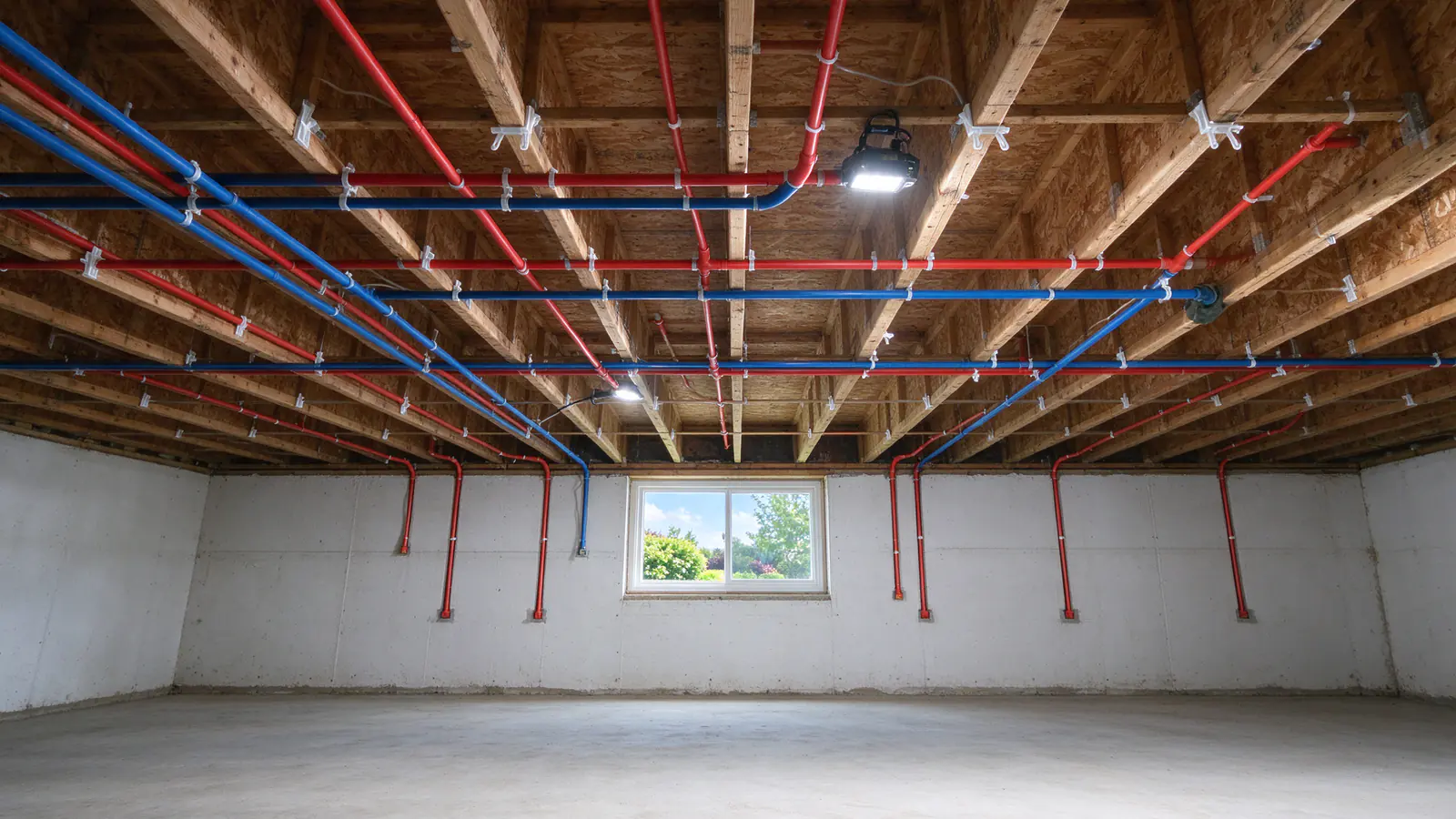
- Installation. New lines are run while the old ones still work. In a house with a basement, the main and many branches run along exposed joists; openings come where pipe has to climb. Each fixture group is then switched over, so the water is off in stages.
- Testing and inspection. The new piping is pressure tested and flushed, the inspector checks it while it is still visible, and the openings are closed.
Old pipe that can be reached is removed. Pipe buried in plaster or between floors is usually cut at both ends, capped and abandoned in place. The guide to how long a repipe takes and the guide to how invasive repiping is cover the schedule and the disruption.
What old pipe costs while it stays
Old pipe has running costs that are easy to miss. A slow leak inside a wall wastes water around the clock, and Columbus water and sewer bills are rising: the City’s current rate schedule raised water rates 18% and sewer rates 8% at the start of the year. A leak that shows up as a ceiling stain also brings drywall, plaster and paint repair, and sometimes flooring.
Low flow costs time and patience more than money, but it changes how a house is used: showers scheduled around the dishwasher, a second-floor bath nobody likes. Rusty first draws mean running water to waste. None of this makes a repipe automatic. It belongs on the same page as the price of the repipe when the decision is made.
Living with a new system
The first days after a repipe have a few normal surprises. Air in the lines spits from faucets until it clears. Aerators and showerheads may catch loosened scale from old pipe that was disconnected, and they should be cleaned after the flush. If a pressure-reducing valve was added or adjusted, flow can feel different from what the house was used to.
A few things are worth checking after the work. Every shutoff should be labeled: the main and each branch or manifold port. Pipe left exposed in an unheated space should be insulated before the first hard freeze. If water hammer appears, a banging when a valve closes quickly, it is a sign of loose support or high pressure, and it is worth a call while the work is fresh. Keep the permit record and the scope with the house papers; the next buyer’s inspector will ask what was replaced and when.
Cost, insurance and programs
A whole-house repipe in the Columbus area typically costs $4,000 to $15,000 or more, with PEX usually lower and copper higher. The Columbus repipe cost guide breaks down what sits inside that number, and the cost estimator gives a planning range without a phone call.
Homeowners insurance generally treats wear and corrosion differently from sudden damage, so a repipe itself is rarely covered, while water damage from a sudden leak may be. The insurance guide explains the difference. Inside Columbus, the City’s lead service line program and its LEAP loan cover the buried service line, not interior piping; the lead service line program guide explains how to plan an interior repipe around that work.
Buying or selling a house with old pipe
A home inspection is often where the subject first comes up. An inspector who sees threaded steel near the meter or gray plastic stamped “PB” will usually note it and recommend a plumber’s evaluation. That note does not say how much of the house is affected or what it would cost, which is why it can stall a sale.
For a buyer, the useful step is to find out what the pipe is and how far it runs before the inspection period ends, then get a written scope and price. For a seller, the same scope lets the conversation be about a number rather than a worry. Either way, the guide to buying a house with old pipes covers what to ask, and the polybutylene replacement and galvanized pipe replacement pages explain how each is handled.
Timing a repipe around the City’s service line work
Inside Columbus, the City is replacing lead and galvanized service lines street by street over a twelve-year program, on both the City’s side and the owner’s side, at no charge to the owner during scheduled replacement while funding lasts. Owners sign a work agreement, and the crews replace the buried line up to the house.
That work stops at the house, and the City notes that interior lead hazards are not part of its replacement. Galvanized branches, lead-soldered copper and old brass valves stay as they were. Because the City’s crew already shuts off the water and works at the basement wall near the meter, some owners plan the interior repipe to follow soon after, so the new service line feeds new house piping rather than old.
Questions to ask before agreeing to a repipe
- What exactly is being replaced, and what old pipe stays in service?
- PEX or copper, and in which layout?
- Where will each wall and ceiling opening be, and who closes it?
- Is the permit in the price, and which office issues it?
- How will the water be shut off, and for how long each day?
- Is a new main shutoff included? Fixture stops? Water heater connections?
- How is the new system tested before the walls close?
A scope that answers all seven is one you can compare against another quote line by line. When you are ready for one, call or request an estimate from Slate Repiping Columbus.