Bexley’s tap water comes from Columbus, but the bill, the service line records and the help with replacing old lines all come from Bexley City Hall. That arrangement shapes every job Slate Repiping Columbus offers in Bexley, from old house repiping to galvanized replacement in PEX or copper, because the questions about the outside of the house go to Bexley rather than Columbus. Licensed and insured plumbing contractors do the work on a Bexley permit, with plan review by Franklin County Public Health.
This matters because much of what Columbus residents read about lead lines, loans and the City’s replacement schedule does not apply on this side of Alum Creek. The houses matter too. On Census figures, 42.5% of Bexley’s homes were built before 1940 and another 35.0% between 1940 and 1959, a median year of 1944, which puts most of them in the era of galvanized supply pipe.
A Columbus source with a Bexley system
Bexley’s water quality report says its water comes from the Hap Cremean plant, Columbus’s plant fed by Big Walnut Creek and Hoover Reservoir, through two master meters. Past those meters, the mains, the meters at each house and the billing belong to the City of Bexley. Columbus’s contract list marks Bexley as a master-meter community, meaning Columbus neither bills nor maintains the local pipes.
For a repipe, the practical effect is in who to call about the outside of the house. Questions about the meter, the curb stop or the service line go to Bexley’s water department, not to Columbus Water & Power. The interior work is the same as anywhere: new supply piping from the main shutoff to every fixture, tested under pressure before walls close.
What Bexley’s service line inventory shows
Bexley keeps its own inventory of 4,363 service line records. On the customer-owned side, 1,681 are copper, 683 plastic and 418 galvanized, while 1,528 are listed as unknown. On the system side, 273 are lead and 1,304 are marked unknown, likely lead. Bexley has mailed notices to owners and says there are few, if any, known private lead lines.
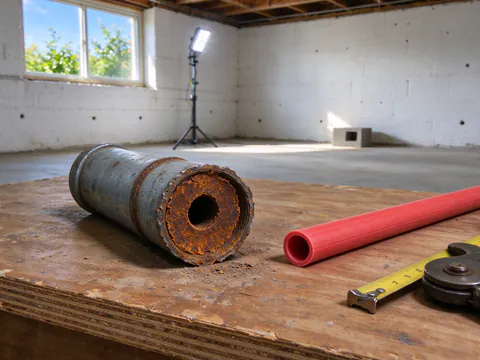
The large unknown count is the useful part for an owner. A third of the private-side records lack a confirmed material, and the material of the service line is a strong hint about the plumbing it feeds. Columbus banned new lead and galvanized service lines in December 1963, and more than three quarters of Bexley’s homes were built before 1960. Checking where the line enters the basement takes a few minutes: a magnet sticks to galvanized, and lead is soft, dull gray and scratches to a bright silver. The guide to identifying pipe material shows each one, and the guide to whether galvanized pipes are safe explains what galvanized means for flow and water quality.
Service line listed as unknown?
A walk-through identifies the service line where it enters the house and traces the supply piping from there to every fixture.
Bexley’s galvanized loan, not LEAP
Columbus’s LEAP loan is limited to owners with a Columbus Water & Power bill, so it does not cover Bexley. Bexley runs its own Galvanized Service Line Replacement Loan instead. It is the lesser of $4,000 or 80% of the project cost, paid directly to the contractor, based on a quote from a City-approved vendor, and the owner has to live in the house. The application ties it to the City’s sewer remediation program, and Bexley’s site describes it as help for service lines disturbed by its annual water main replacement.
The loan covers the service line, not the pipe inside. If the City’s main work is coming to your street, it is a natural moment to plan the interior as well, so the new service line connects to new house piping rather than to old galvanized. The water line replacement page covers the buried line, and the galvanized pipe replacement page covers the inside.
How a repipe runs in a tall prewar house
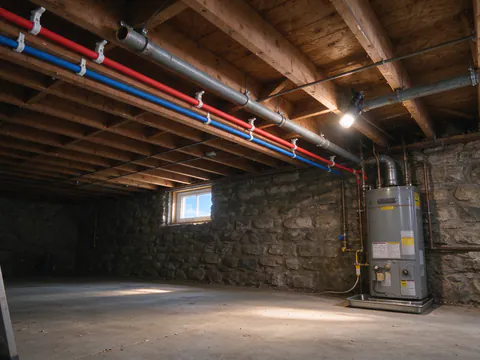
Bexley’s houses are tall and mostly over basements. County Auditor records show 82.0% with a full basement and 68.3% at two stories or more. The basement is where the work begins: a new main along the joists from the shutoff, branches to the kitchen and laundry, and the water heater reconnected. The difficult part is getting to upstairs baths, including any bath on a third floor, through walls that are often plaster on lath.
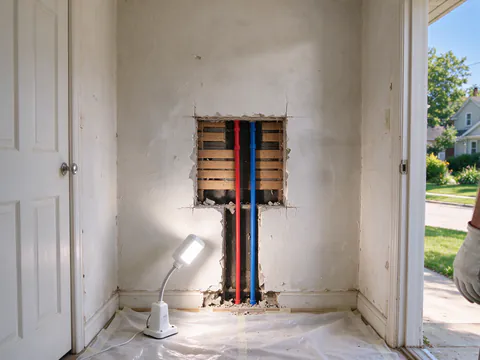
Good routes follow what the house already gives: a closet stacked under a bath, the chase beside an old cast iron soil stack, or a back stair wall. Each opening is cut for access and patched afterward, and plaster takes more care to match than drywall. The how invasive is repiping guide explains how that is planned. Drains and soil stacks are a separate system, and the cast iron stack replacement page covers them when they need attention.
A supply line that climbs an outside brick wall to reach a second-floor bath is the one most exposed in a January cold snap. Planning the route is the time to bring it inside, into a heated chase or a partition wall, and to insulate any short section that cannot move.
The permit path in Bexley
The City of Bexley’s Building and Zoning Department issues the plumbing permit. Franklin County Public Health reviews the plumbing plans and inspects under its contract with the City, and since February 9, 2026 the City’s application has to include FCPH’s plan review approval with a matching fixture count. That means the full fixture list is settled before the permit goes in. The repiping permit guide compares this with the City of Columbus process. Fees are set locally and are worth confirming with the building department at application.
Cost in Bexley
Height, plaster and the number of baths are the main reasons a Bexley house lands where it does within the typical Columbus-area range of $4,000 to $15,000+ for a whole-house repipe. Larger multi-bath, copper or complex homes run higher. The repiping cost guide breaks the drivers down, and the cost estimator gives a planning range.
Close to Bexley
West toward downtown, German Village shares Bexley’s prewar profile under the City of Columbus permit. Clintonville and Grandview Heights are covered too, and the service areas page lists the rest.