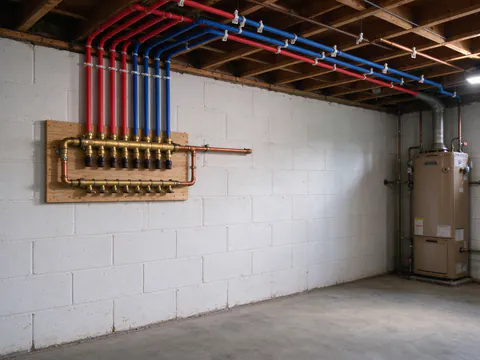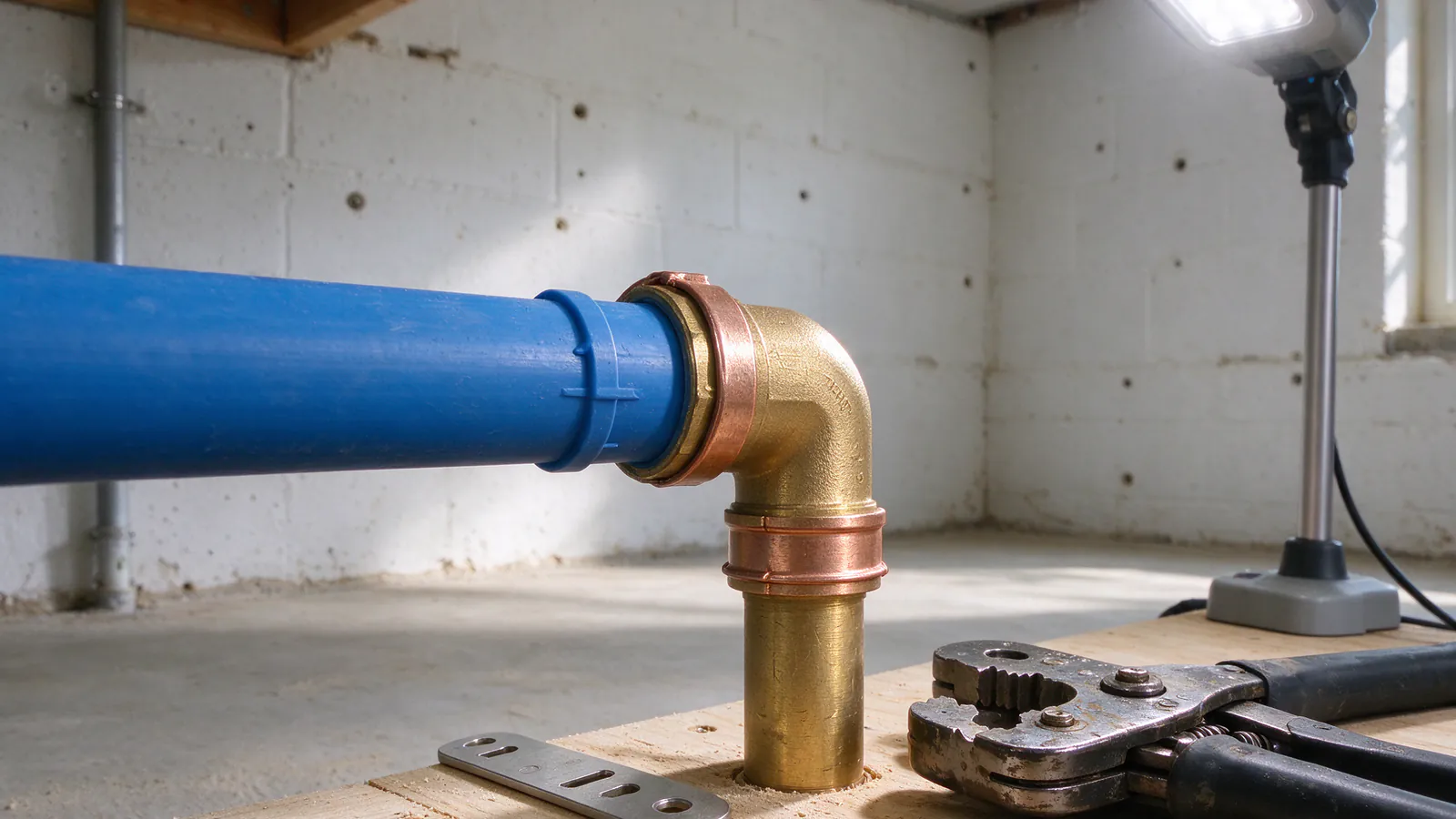
For most Columbus houses, PEX costs less and needs fewer wall openings, while copper suits owners who want rigid metal pipe and runs that stay exposed. The Ohio Plumbing Code allows both, so the choice turns on the house, not the law. Neither is the right answer for every home.
Slate Repiping Columbus offers and manages PEX repiping and copper repiping across Columbus and nearby Franklin County communities, carried out by licensed and insured plumbing contractors. This guide sets out the trade-offs as they apply to Columbus water, Columbus winters and Columbus houses.
What the code allows in Columbus
The Ohio Plumbing Code (OAC 4101:3) is built on the 2021 International Plumbing Code, and that code lists PEX, CPVC and copper tube for water distribution. Under the Residential Code of Ohio, the plumbing code governs 1, 2 and 3 family homes, so the same material list applies in a Clintonville bungalow, a German Village double or a Hilliard two-story. Each product has to be installed to its listing and the manufacturer’s instructions, and the work needs a plumbing permit; the Columbus repiping permit guide covers who issues it.
One part of the system is not a choice. Inside Columbus, the City requires Type K soft copper for 2-inch and smaller service pipe from the main through the curb stop, so the buried line from the street usually stays copper even when everything inside the house becomes PEX.
PEX and copper side by side
| Question | PEX | Copper |
|---|---|---|
| Typical Columbus-area whole-house range | $4,000 to $12,000 | Roughly $6,000 to $18,000+, depending heavily on house size |
| Material price movement over a year (BLS PPI) | Plastic pipe up about 4 to 5% | Copper mill shapes up about 30% |
| Wall openings | Usually fewer and smaller; tubing bends around framing | Usually more; rigid runs need straight paths and fittings at each turn |
| Joints | Crimp, clamp or expansion fittings; fewer of them | Soldered or press fittings at every change of direction |
| Sunlight | Must be shielded from UV after installation | Not affected |
| Freezing | Can stretch slightly; fittings and tubing can still fail | Can split; joints can open |
| Rodents in crawlspaces or attics | Can be chewed | Not a concern |
| Exposed runs on a basement ceiling | Works, but sags without enough support | Looks tidy and stays rigid |
The ranges are typical Columbus-area ranges, not quotes. The Columbus repipe cost guide explains what sits inside each number.
Cost: why the gap has widened
PEX usually costs less for two reasons. The tubing costs less per foot, and it takes less labor: one length can run from the basement to a second-floor bath with few fittings, where copper needs an elbow at each turn and a joint at each one.
The material gap has also grown. In the Bureau of Labor Statistics producer price index, copper and brass mill shapes were about 30% higher than a year earlier, while plastic pipe rose about 4 to 5%. That movement shows up in copper quotes more than in PEX quotes. Labor is not the reason for the difference: BLS puts the median plumber wage in the Columbus metro at $30.41 an hour against $30.67 nationally, so a copper job costs more here for the same reasons it does anywhere.
Columbus water and both materials
Columbus lime-softens its water and adds a zinc orthophosphate corrosion inhibitor, according to the City’s water quality report. Plant results show hardness of about 5.7 to 7.3 grains per gallon and a pH near 7.8. That is moderately hard water that has been treated to protect pipe walls, which is why a single pinhole in a Columbus copper line does not prove the water is eating the pipe.
Hard water does not choose for you. PEX tubing cannot corrode, but a PEX system still has brass or plastic fittings, and fittings are where its chemistry questions sit. Copper’s known weak point is pitting in particular runs, for reasons that range from water velocity to workmanship; the copper pinhole leak guide covers those. Scale building up inside either material is rarely the deciding issue on treated City water. The Columbus water pressure and hard water guide goes further into the chemistry.
Freezing, rodents and sunlight
These three are where honest comparisons usually stop being one-sided.
Freezing. Columbus averages about 103 nights a year at or below 32 degrees at the airport station, and about 10 a year at or below 10 degrees, by NOAA’s climate normals. PEX can stretch a little when the water inside freezes, so it sometimes survives a freeze that would split copper. It is not freeze-proof: fittings can pull apart and tubing can still burst in a hard freeze. Pipe in an exterior wall, a crawlspace or an unheated garage is at risk whatever it is made of. A repipe is the moment to move lines to interior walls and insulate what has to stay near the cold.
Rodents. Mice and other rodents can chew plastic tubing where they get into a crawlspace or attic. Copper is not a target. In a house with a dry, sealed basement this rarely matters; in a house with a vented crawlspace and a rodent history, it is worth raising before choosing PEX for that section.
Sunlight. PEX breaks down under ultraviolet light, so it cannot run exposed outdoors or sit in sunlight through a basement window, and it has limits on how long it can be stored uncovered before installation. Copper has no UV concern. Every PEX line has to be covered or shielded once it is in.
Weighing PEX against copper for your house?
A walk-through looks at access, cold spots and exposed runs before anyone picks a material.
Access, openings and older Columbus houses
Access is often what tips the decision. About 51% of Columbus homes on the County Auditor’s records have a full basement, and in most of them the main and many branches can run along exposed joists in either material. The difference shows where pipe has to climb. Flexible PEX can be pulled up through a wall cavity from a small opening at the top and bottom; rigid copper usually needs more openings to make each turn.
In a two-story brick house with plaster walls, that difference is real money and real mess, because plaster patching costs more than drywall patching. In a one-story ranch with an open basement, it can be small enough that copper’s higher price is the only gap left. The guide to how invasive repiping is shows where openings usually land.
Layout, flow and noise
PEX can be laid out trunk-and-branch like copper or as home runs from a manifold, where each fixture gets its own line from a valve panel. Each has trade-offs in tubing length, hot-water wait and the number of hidden fittings, and the manifold vs trunk-and-branch guide compares them.
Sizing matters with PEX. Some fitting types narrow the bore at each joint, so a PEX system has to be sized for that, or a shower can feel weaker than it did on old copper. Homeowners report slower showers and longer hot-water waits after poorly planned PEX jobs; both trace to design, not the material. PEX’s flexibility also absorbs some of the surge that causes water hammer, while copper can transmit more noise along a rigid run unless it is well supported.
Two details owners often miss
Electrical bonding. In many older houses, the metal water pipe was part of the electrical bonding path. Replacing it with plastic can change that. An electrician should check bonding when a repipe replaces metal pipe with PEX.
Mixed systems. Choosing PEX does not mean every inch is plastic. Copper or brass often stays at the water heater connections, the main shutoff and some exposed runs. Transitions have to use listed fittings, and the written scope should say which material runs where. Where galvanized steel meets copper, the transition needs the right fitting too; the galvanized pipe replacement page covers that interface.
Which one fits your house
PEX tends to fit when the budget matters, when pipe has to snake through finished walls, when plaster makes every opening expensive, or when the house has long runs to an upstairs bath. Of the repipe-type permits in the Franklin County Auditor’s records that name a material, PEX appears more often than copper.
Copper tends to fit when runs stay exposed, when a crawlspace has a rodent history, when lines pass near heat or sunlight, or when the owner simply prefers metal pipe and accepts the higher price. Neither choice removes the need for a pressure test before walls close, support at the right spacing, and protection from cold. Whether PEX is safe for drinking water is a separate question, covered in its own guide. To compare both for a specific house, start with the repiping cost estimator or call to set up a walk-through.