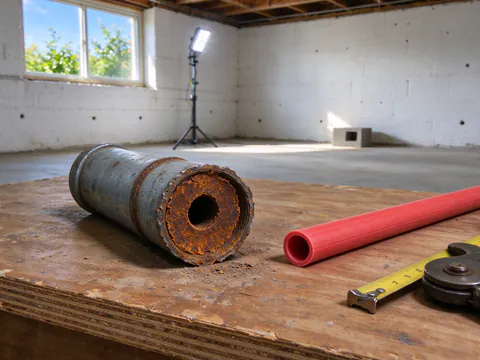
Often, yes, if you know what you are buying. Galvanized supply pipe is a known cost once it is scoped, not a hidden defect. Before the inspection period ends, find out how far the galvanized runs, check the service line on the City’s map, and get a written scope and price, then negotiate from that number. Slate Repiping Columbus offers and manages galvanized and polybutylene replacement across Columbus and nearby Franklin County communities, carried out by licensed and insured plumbing contractors, and can scope a house during a buyer’s inspection period with the seller’s permission.
Reading the inspection note
A home inspector who sees threaded steel pipe near the meter, or gray plastic stamped “PB,” will usually note it and recommend a plumber’s evaluation. That note is useful, but it is narrow. An inspector looks at what is visible in a few hours. The note rarely says:
- How far the old pipe runs. Many Columbus houses have a mix: galvanized near the meter, copper where a past owner fixed a leak, galvanized again upstairs.
- What is inside the walls. The pipe in the basement ceiling may not match the pipe that climbs to the bathroom.
- How the water behaves. Low flow at the upstairs shower with the kitchen tap open is the most telling galvanized symptom, and it only shows if someone tests for it.
- What the service line is. The buried pipe from the street is a separate question with its own program.
The guide to identifying your pipe material shows how to tell galvanized from copper and plastic with a magnet and a coin, which you can do during a showing.
What to find out before closing
Make a short list and work through it before the inspection contingency runs out.
- The pipe at the meter. Galvanized, copper, plastic or lead, and whether the main shutoff turns.
- The pipe as far as you can follow it. Across the basement ceiling, up to the first floor, into the water heater.
- Flow upstairs. Run the highest shower, then open the kitchen tap and watch what happens.
- Repair history. Ask the seller about leaks, where they were and what was replaced.
- Permits. A past repipe should have a permit record. The Franklin County Auditor’s records carry permit descriptions reported by many cities.
- Copper joints. In copper installed before 1986, joints may contain lead solder, the year lead solder was banned in home plumbing.
- The service line, covered next.
Checking the service line on the City’s map
Inside Columbus and the communities it serves directly, the City publishes a service line inventory map, linked from its lead service line replacement program page. Look up the address to see the recorded material on the City’s side and the owner’s side. Columbus stopped allowing new lead and galvanized service lines in December 1963, so a house built before then is more likely to have one.
The numbers vary sharply by area. Within the City of Columbus, 8.1% of service line records show galvanized on the owner’s side. In Grandview Heights it is 31.0%, and in the 43206 ZIP around German Village, 21.4%. Some records are marked unknown, so the map is a starting point, not a final answer.
Two program details matter to a buyer. The City is replacing lead and galvanized service lines street by street at no charge to the owner during scheduled replacement while funding lasts, but only the owner listed on the Franklin County Auditor’s record can sign the work agreement. If your street is in an active area, ask whether the seller has signed, and plan to sign once the deed is recorded. And if the seller used the City’s LEAP loan for a service line, that 0% deferred lien is repaid in one lump sum at sale, so a title search will show it. The Columbus lead service line program guide covers both programs.
Outside Columbus, rules differ. Bexley keeps its own inventory and sent notices to owners, and other suburbs notify their own residents.
Polybutylene in the inspection report
Polybutylene is a gray, sometimes blue or black, flexible plastic found in some homes built or remodeled in the 1980s and 1990s. It is often stamped “PB2110.” Its weak points are usually its fittings, which is why it is generally replaced as a system rather than patched. Some insurers ask about it. The polybutylene pipe replacement page explains how it is handled, and the insurance guide covers how policies tend to treat old pipe.
Buying a house with old pipe?
A walk-through during your inspection period traces the pipe from the meter and puts a scope and price in writing.
Getting a scope and price before closing
With the seller’s permission, a plumbing walk-through during the inspection period does what the inspector cannot: traces the supply from the meter to each fixture, checks static and flowing pressure, notes the openings a repipe would need, and puts a scope and price in writing. That document is what makes a negotiation concrete.
For planning, a whole-house repipe in the Columbus area typically runs $4,000 to $15,000 or more, with PEX usually from $4,000 to $12,000 and copper roughly $6,000 to $18,000 or more, depending heavily on house size. These are typical ranges, not quotes. The repipe cost guide explains what moves a house up or down.
Buy, negotiate or walk away
| What the scope shows | Typical response | Why |
|---|---|---|
| Galvanized only near the meter, copper beyond | Negotiate a small credit or accept | A short partial repipe may cover it |
| Galvanized throughout, flow still acceptable | Negotiate a credit for a repipe | Known work, can be planned after closing |
| Galvanized throughout with leaks or low flow | Negotiate firmly, or plan the repipe before moving in | Work is needed soon and is easier in an empty house |
| Polybutylene throughout | Negotiate a credit, check insurance early | Usually replaced as a system |
| Water damage, rotted framing or mold from old leaks | Get further inspection before deciding | The pipe is the smaller problem |
A credit or price reduction usually gives the buyer more control, because the buyer then chooses the material, the layout and who does the work. A seller repair can be fine if the agreement names the scope, requires the permit and final inspection, and lists any old pipe that stays. Without that, a seller may choose the narrowest scope that clears the inspection note.
After you move in
An empty house is the easiest time to repipe: no furniture to move and no daily routine to work around. If the repipe waits, keep the scope with the closing papers so the next decision starts from facts. The guide to whether galvanized pipes are safe and the galvanized pipe replacement page cover what comes next. Call Slate Repiping Columbus to set up a walk-through before your inspection period ends.