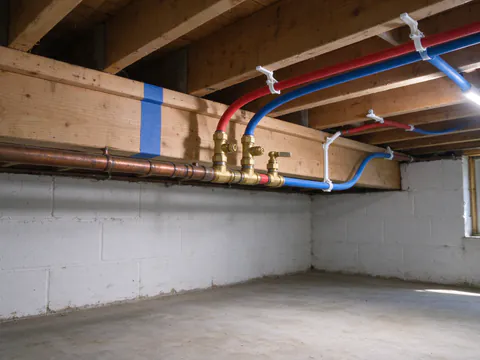
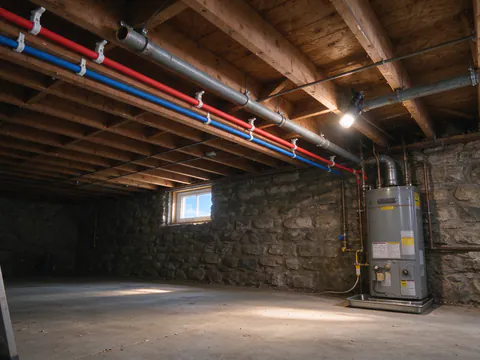
Look up at the basement ceiling in many Clintonville houses and the plumbing history is laid out along the joists: gray threaded steel in one run, bright or dark copper in another, and a few fittings where the two meet. For houses like these in Clintonville, Beechwold, Glen Echo and Old North Columbus, Slate Repiping Columbus offers everything from a partial repipe that clears out the last galvanized branches to a full replacement in PEX or copper. Licensed and insured plumbing contractors carry out the work under a City of Columbus permit.
The mix makes sense for the era. Census figures for ZIP 43214 put the median home at 1955, with 36.4% built between 1940 and 1959 and another 22.2% before 1940. That spans the decades when steel pipe gave way to copper in houses like these, and many have had leaks repaired one section at a time since. The decision here is less often “do I have old pipe” than “how much of it is left, and is it worth finishing the job”.
Two metals in one basement
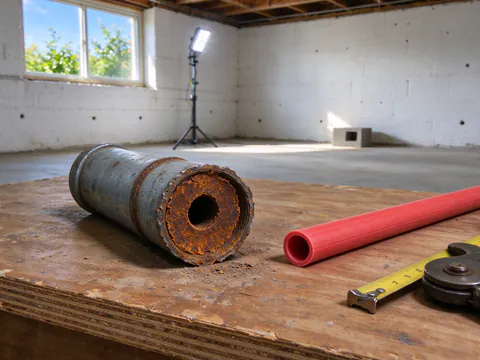
A house where copper and galvanized share the system behaves like an old one. Galvanized steel narrows from the inside as rust builds up, so a short run of it near the meter or the water heater can restrict flow to every fixture after it, however new the copper downstream. Rust that shows at the tap after the water sits is also more likely to come from that remaining steel than from the copper. The guide to identifying pipe material covers how to tell the metals apart with a magnet and a scratch test.
Joints between the two deserve their own look. Where copper was connected straight to steel without a proper transition fitting, the joint can corrode more quickly than either pipe. A short line of green or white crust at one of these points is a reason to trace the whole system, not just patch the joint. Whether that leads to a repair or a repipe is a judgment the repipe vs repair guide walks through step by step.
Why a one-story house over a basement is easier to repipe
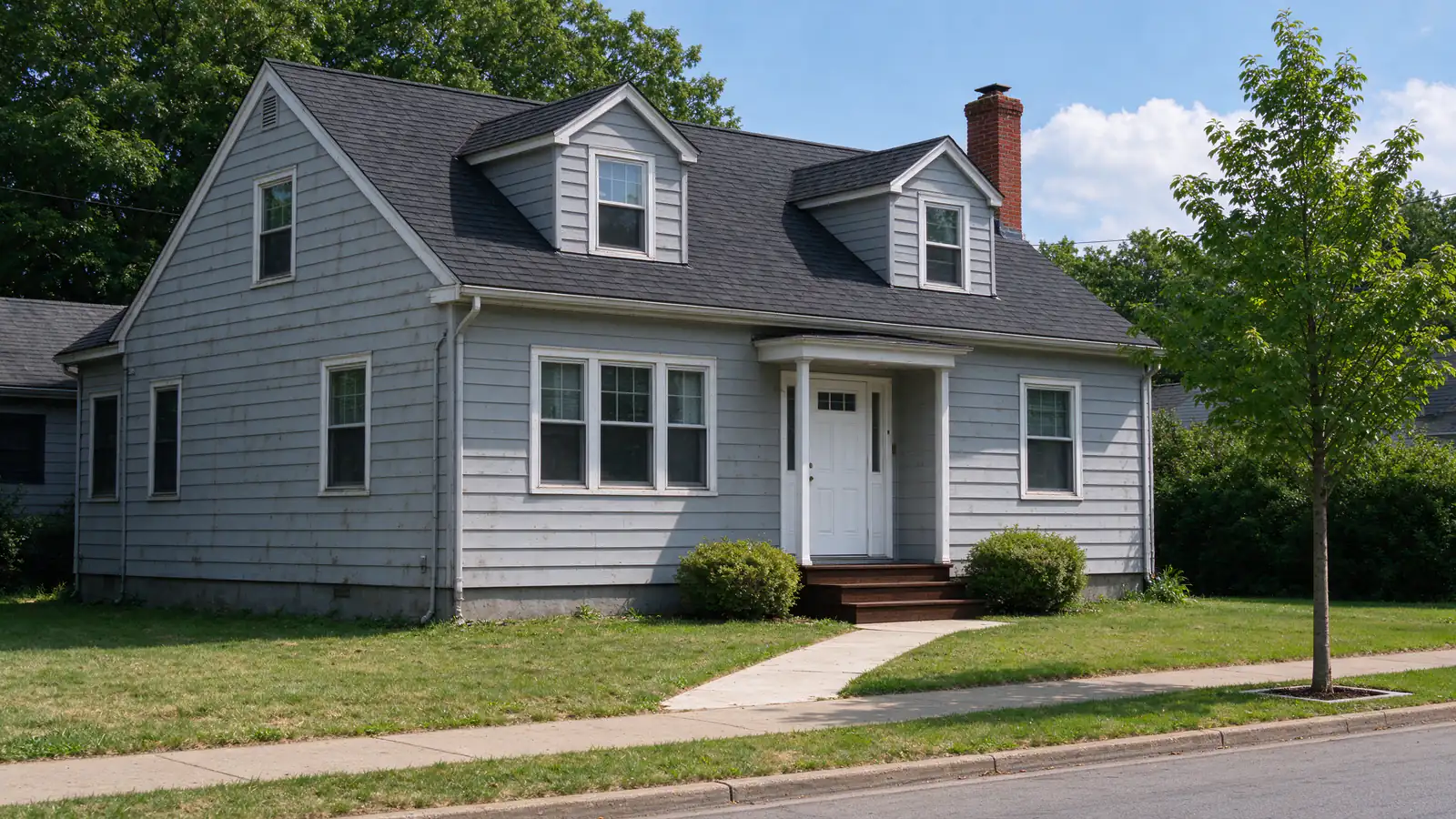
The County Auditor’s records for Columbus-city parcels in 43214 show 74.9% of homes with a full basement and 56.7% of them one story. Put together, that describes the simplest repipe layout there is. The new main runs from the shutoff along open joists, each branch turns up through the floor under its fixture, and the kitchen, bath and laundry sit only a few feet above the work. Most openings land inside a vanity cabinet, a closet floor or the back of a kitchen base, rather than in plaster walls.
The harder houses are the story-and-a-half and two-story homes, which make up about a third of the cards. A bath tucked under the roof slope needs a route up through a closet or an interior partition, and the plaster in older homes needs careful openings and patching. The how invasive is repiping guide explains how the wall work is planned and closed up.
Freezing is a factor in any route. NOAA’s normals for the airport station show about 103 nights a year at or below 32°F, and lines inside an exterior wall or above an unheated porch are the ones most at risk. A repipe is the chance to move them to interior walls or heated basement space. Where a run has to stay near the outside, insulating it is part of the scope.
Mixed pipe overhead?
A walk-through follows the main and each branch from the meter and marks what is galvanized, what is copper and where they meet.
The basement you plan to finish
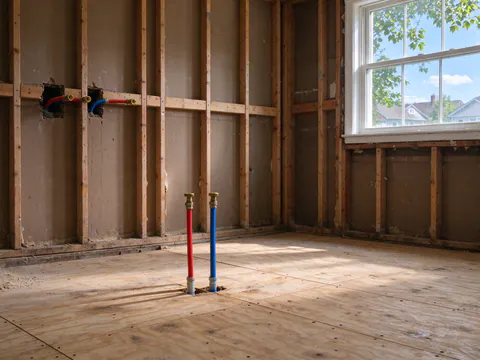
If the basement is the next room you plan to finish, settle the plumbing first. Before the framing goes up, the supply lines along the ceiling are worth a decision, because a finished ceiling turns the easy part of a repipe into demolition and patching. Replacing the pipe first, or at least replacing every galvanized section that will be covered, keeps the new room from hiding the oldest part of the system. The repiping during renovation page covers how the two jobs are sequenced, including pressure testing the new lines before anything closes over them.
Old North Columbus and Beechwold
Old North Columbus
South of Clintonville, Old North is older and denser. In ZIP 43202, 41.3% of homes were built before 1940 and 21.4% of units are in buildings of two to four, including doubles and converted houses near campus. Its service line numbers are also stronger: 20.6% of lines galvanized on the owner’s side and 45.8% lead on the City’s side, close to half. Where two households share a basement, the walk-through traces which unit each line serves, and the commercial and multi-unit repiping page covers larger buildings.
Beechwold
Beechwold, on the north end along North High Street, falls inside the 43214 figures and has no separate data of its own. The approach is the same as the rest of Clintonville: find out how much galvanized pipe is still in service, then decide between finishing the job in sections or replacing the system in one visit.
Service lines and the permit
The buried service line from the main to the house is a separate question from the pipe inside. In 43214 the City’s inventory shows 14.5% of lines galvanized on the owner’s side and 24.3% lead on the City’s side, and its program has 277 signed work agreements in that ZIP and 369 in 43202. The Columbus lead service line program guide explains how the City’s work on the street side fits with a repipe on the house side.
All of these neighborhoods are inside the City of Columbus, so Building and Zoning Services issues the plumbing permit and inspects. ZIP 43214 recorded 862 residential plumbing permits from 2023 through 2025, the most of any Columbus ZIP, though the City’s data does not say how many were repipes. For a 1, 2 or 3 family home the permit is $275 with two inspections. The repiping permit guide explains who can pull it and what the inspector looks for.
On price, the house matters far more than the street. The typical Columbus-area range for a whole-house repipe is $4,000 to $15,000+, and the repipe cost guide and cost estimator show where a given house is likely to sit.
Nearby areas
West across the Olentangy River and SR-315, Upper Arlington and Grandview Heights have their own building departments and a different permit path. South of downtown, German Village has a larger share of prewar brick and doubles. Other neighborhoods are on the service areas page.