The City of Columbus puts the cost of replacing a lead or galvanized service line at about $6,000 to $10,000 per property when the owner pays for it outside the City’s schedule. When the City’s program reaches a street, it intends to cover that cost for owners who sign the work agreement, as long as funding lasts. Slate Repiping Columbus offers and manages lead service line replacement for owners outside that schedule; this guide covers what sets the price and what helps pay it.
The City’s figure, and why the range is wide
The $6,000 to $10,000 range is the City of Columbus’s own figure for a service line replacement, given on its lead service line program page. It is not a quote. A specific line can land anywhere in that range or outside it, because the work underground is different at every address. No other public figure for Columbus service line work exists, so anything more precise comes from a written quote after the line is looked at.
What moves the price
Length of the run
The private side runs from the curb stop near the street to the meter inside the house. A house set close to the sidewalk has a short run; one set back on a deep lot has a long one. Anyone buying a house with old pipes can pace the distance from the curb to the meter wall to get a sense of it. More length means more copper, more trench or a longer pull, and more restoration.
Depth and frost
A new line in Columbus has to sit below the 32-inch frost line Building and Zoning Services sets for the city. If the old line is shallower, or the ground slopes, the trench or pits get deeper. Deeper excavation takes longer and needs more care to keep the sides from collapsing.
What sits on the route
Lawn is the simplest surface to cross. A sidewalk, a concrete or asphalt driveway, a porch, a retaining wall or a mature tree along the route either has to be cut and restored or worked around. Who repairs a cut sidewalk or driveway, and to what standard, is one of the main differences between quotes.
Trench or pull
An open trench exposes the whole route. Pulling or boring the new line between two pits disturbs less of the yard, but it still means digging at the curb stop and at the foundation, and rocks, roots, other utilities or an old line that will not pull can change the plan partway through. The water line replacement page describes both methods.
The ends of the line
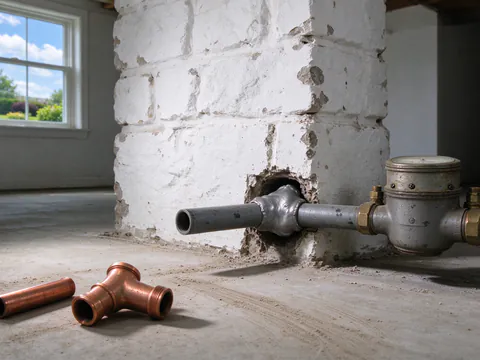
The curb stop, the foundation entry and the meter setting each have their own work. Under the City’s rules, 2-inch and smaller service pipe is Type K soft copper from the main through the curb stop, with Type K copper or approved poly tubing from the curb stop through the meter setting. A reused tap that turns out to be lead or galvanized is abandoned at the main. A new opening through an old stone or brick foundation takes more work than one through a poured wall.
| Factor | Pushes cost down | Pushes cost up |
|---|---|---|
| Run length | House close to the sidewalk | Deep lot, long setback |
| Depth | Old line already below 32 inches | Shallow old line, sloped yard, deep trench |
| Surface | Lawn only | Sidewalk, driveway, porch, trees, retaining wall |
| Method | Clear route, line pulls between pits | Obstructions, rock, old line that will not pull |
| Ends | Accessible curb stop, simple meter setting | Curb stop under paving, old foundation, meter changes |
The free route: the City’s program
If the line is lead or galvanized and inside the City’s water system, the cheapest route is usually the City’s own street-by-street replacement. When construction reaches a street, the City intends to replace both the public and private side with copper at no direct cost to owners who sign the work agreement, while funding remains. Only the owner of record with the Franklin County Auditor can sign. The Columbus lead service line program guide explains the schedule and how to check an address.
The catch is time. The program is planned over about 12 years, and the City does not reimburse owners who replace a line themselves before their street comes up.
LEAP: a 0% loan for the line
The Lead Elimination Assistance Program (LEAP) is for owners who replace a lead or galvanized line outside the schedule. Any property owner with a Columbus Water & Power bill can apply.
- Amount: up to $10,000, or no more than $4,000 with fewer than three quotes.
- Terms: 0% interest, recorded as a lien on the property, repaid in one payment at sale or a cash-out refinance, or within 99 years. There is no monthly payment plan.
- Contractor: chosen by the owner, certified to work on water service lines and registered with City vendor services. The City pays the lowest of the three quotes.
- Order of steps: quotes, then a three-party agreement between owner, contractor and City, then a notice to proceed. Work started before that is not reimbursed.
- Leaks: leaking lines qualify, and replacement is free for income-qualified owners whose line is leaking.
Restoration can be included in the loan only when it is in the same contractor’s quote, so the quote should list the sidewalk, driveway and lawn work rather than leaving it to a second company.
Need a quote that counts for LEAP?
Ask for a written scope that lists the run, the method and the restoration, so it can sit alongside the other two.
Bexley’s galvanized service line loan
Bexley buys its water from Columbus through master meters and runs its own program. Its Galvanized Service Line Replacement Loan is for owners taking part in the City of Bexley’s sewer remediation work. The loan is the lesser of $4,000 or 80% of the project cost, is paid directly to the contractor, needs a quote from a Bexley-approved vendor, and requires the owner to live in the house. Bexley’s pages are the place to confirm current terms for a specific address. Other suburbs that buy Columbus water, and Westerville with its own system, set their own rules, confirmed per address.
Permit and inspection
Inside Columbus, Building and Zoning Services inspects water service lines from the meter to the building’s distribution system. The work needs a Water Service Installation permit, which carries a Water Service Plan number from Public Utilities and is issued only to registered contractors approved for that work, with two inspection trips included. Work on the City service pipe itself requires a City of Columbus water contractor license. The City does not list a separate fee for that permit in its published schedule, so it is a line to confirm in each quote. The Columbus repiping permit guide covers the different permit for pipe inside the house.
What the price does not include
Every program and figure on this page stops at the meter. Lead solder on copper joined before 1986, brass fittings made before 2014 with up to 8% lead, and galvanized pipe inside the house are replaced as a separate repipe. The repiping cost guide covers that price, and galvanized pipe replacement covers the work. The guide to whether galvanized pipes are safe explains why the inside pipe matters once the outside line is copper.