Columbus water has some hardness, but the City softens it at the plant. The City’s 2025 water quality report puts hardness at about 7.3 grains per gallon from the Dublin Road plant, 5.7 from Hap Cremean and 7.2 from Parsons Avenue, with a pH around 7.8 and a zinc orthophosphate corrosion inhibitor. No Columbus static pressure range is published, so a gauge at your own hose bibb is the only real number. Slate Repiping Columbus offers and manages repipes and pressure-valve work across Columbus and nearby Franklin County communities, carried out by licensed and insured plumbing contractors.
Columbus water by treatment plant
Columbus Water & Power runs three treatment plants. Dublin Road draws from the Scioto River, Hap Cremean from Big Walnut Creek and Hoover Reservoir, and Parsons Avenue from groundwater wellfields. Each softens its water with lime, then adds carbon dioxide to bring the pH back to about 7.8, and finishes with a zinc orthophosphate corrosion inhibitor. The figures below are plant tap results from the City’s 2025 Drinking Water Consumer Confidence Report.
| Plant | Hardness | Grains per gallon (range) | pH | Total alkalinity | Chloride |
|---|---|---|---|---|---|
| Dublin Road | 125 ppm | 7.3 (7.1 to 7.7) | 7.8 | 63 ppm | 62 ppm |
| Hap Cremean | 98 ppm | 5.7 (5.0 to 6.9) | 7.8 | 39 ppm | 31 ppm |
| Parsons Avenue | 123 ppm | 7.2 (7.1 to 7.4) | 7.9 | 43 ppm | 62 ppm |
The City lists chloride sources as naturally occurring and road salt. Across the system, the report gives orthophosphate at 0.44 ppm and zinc at 0.256 ppm. In the City’s most recent lead and copper sampling, from 2023, the 90th percentile was 1.3 parts per billion for lead and 0.049 ppm for copper, with none of 50 sites over the action level.
What that chemistry means for pipe
Softened, pH-adjusted water with a corrosion inhibitor is kind to most pipe. Scale buildup is modest compared with untreated hard water, and the orthophosphate helps form a protective film on metal pipe walls.
Galvanized steel still corrodes from the inside, because the zinc coating wears through over decades no matter what water runs through it. The rust and scale that narrow an old galvanized main were built over many years and are not undone by today’s treatment. The guide to whether galvanized pipes are safe and the rusty water guide cover what that means.
Copper generally does well in this water, so a single pinhole in a Columbus house does not prove the water is attacking the pipe. Velocity, workmanship, flux and stray electrical current are other possible causes. A repeated pattern in one run is worth a closer look, which the copper pinhole leak guide walks through.
PEX is unaffected by scale and corrosion in the way metal pipe is, though its fittings and listing still matter. The PEX vs copper guide compares the two for Columbus water.
Bexley, Westerville and other suburbs
Not every nearby city drinks the same water on the same terms. Bexley buys water from Columbus through two master meters and receives Hap Cremean water, by its own 2025 report, but keeps its own billing and inventory. Westerville runs its own water plant, and its water specifics are confirmed per address. Many other suburbs, including Upper Arlington, Grandview Heights, Dublin, Hilliard, Whitehall and Worthington, are full-service Columbus water customers.
Water pressure in Columbus: what is and isn’t published
Columbus does not publish a static water pressure range for homes, and no honest page should quote one. Pressure at a house depends on its elevation, the size and age of the main in the street, the size and material of its service line, and demand at that moment.
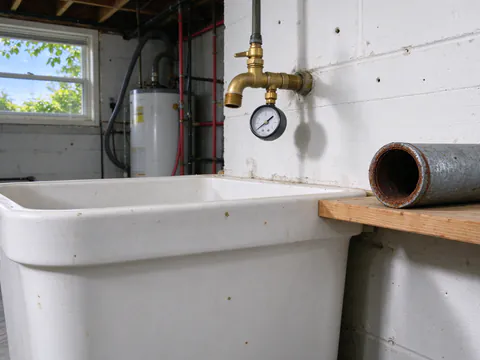
The only reliable number is a reading at your own house. A pressure gauge screwed onto a hose bibb or a laundry faucet, with nothing else running, shows static pressure. Opening a tub faucet upstairs while watching the gauge shows how far it drops under flow. A large drop with good static pressure points at restriction in the house piping; a low reading at both points toward the service line, a failing valve or the supply. The low water pressure page explains how that reading is used.
Pressure swings
Pressure that changes from hour to hour has several possible causes. Demand on the street rises in the morning and evening. A pressure-reducing valve that is wearing out can let pressure creep up overnight and drop under use. City main work nearby can change pressure for a while.
There is also thermal expansion. When a water heater warms water in a closed system, one where a check valve, backflow preventer or pressure-reducing valve keeps expanded water from pushing back into the main, pressure climbs during each heating cycle. Dripping relief valves and banging pipes can follow. The plumbing code calls for thermal expansion control in that situation, usually an expansion tank sized for the heater.
Want your pressure measured?
A walk-through reads static and flowing pressure at the house and traces the pipe from the meter before anyone talks about scope.
When a pressure-reducing valve belongs
The International Plumbing Code, which the Ohio Plumbing Code incorporates with Ohio amendments, generally requires a pressure-reducing valve where static pressure inside a building exceeds 80 psi. No Ohio amendment to that section was found in the state’s water supply chapter. So the test is simple: if a gauge reads above 80 psi with nothing running, a pressure-reducing valve belongs on the main.
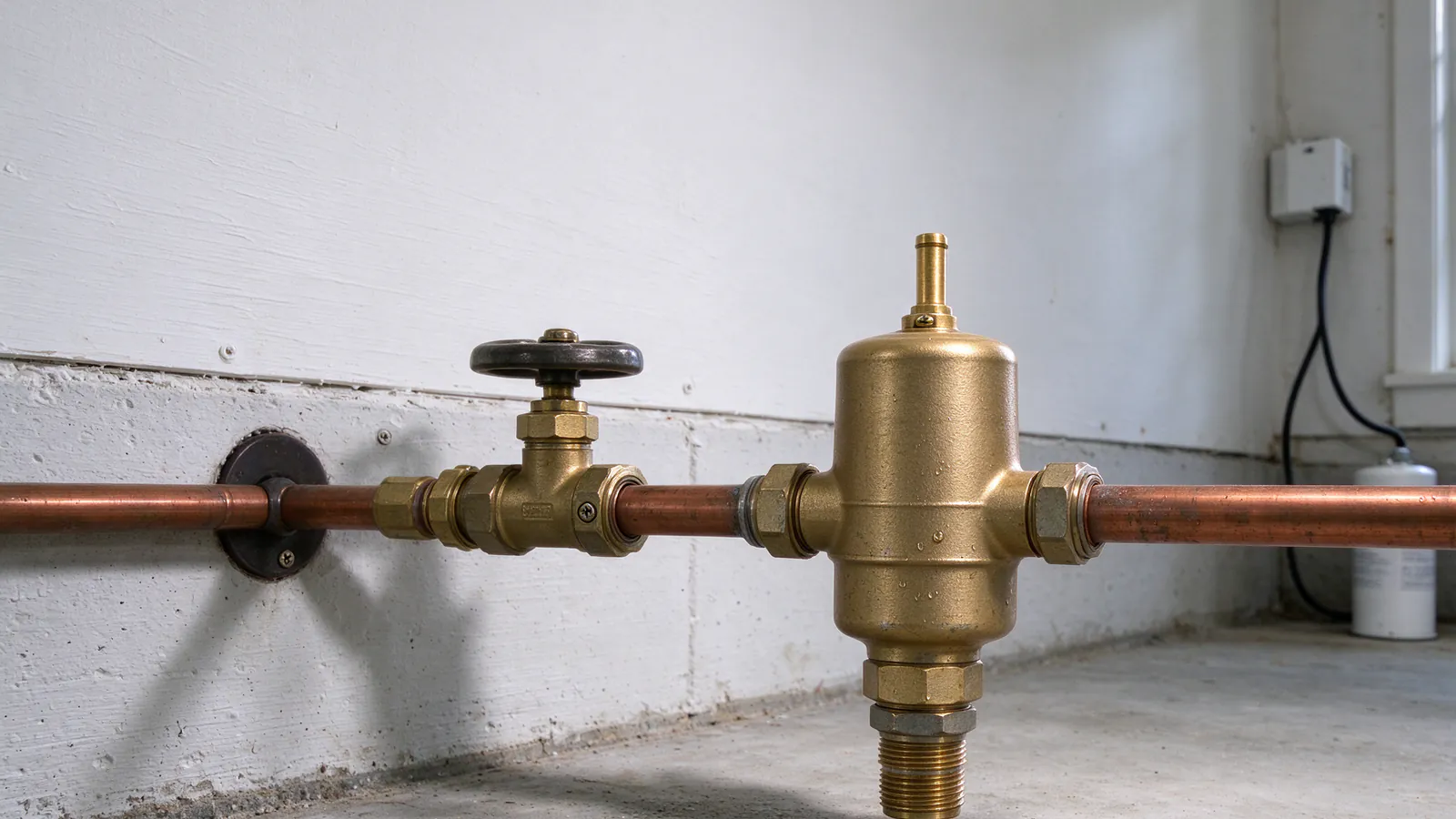
Pressure that is too high stresses fittings, fixture valves, toilet fill valves and appliance hoses, and can make water hammer worse. A pressure-reducing valve also wears, so a house that has one should have it checked when other work is done. A repipe is a natural time: the main shutoff, the valve and the expansion tank are all at the same spot near the meter, where the Columbus service line usually enters the basement. If the service line itself is old galvanized or lead, the water line replacement page covers that separate job.
What a repipe can and can’t change
A repipe replaces restricted pipe inside the house. Where scaled galvanized is choking flow, new PEX or copper can restore it. A repipe cannot raise the pressure arriving from the street, and it will not correct a failing pressure-reducing valve unless the valve is in the scope. That is why a walk-through checks pressure before setting a scope. The whole-house repiping page and the manifold vs trunk-and-branch guide cover how new piping is sized for flow. Call Slate Repiping Columbus to have the pressure measured and the pipe traced.